
San Jose City Directory Holdings
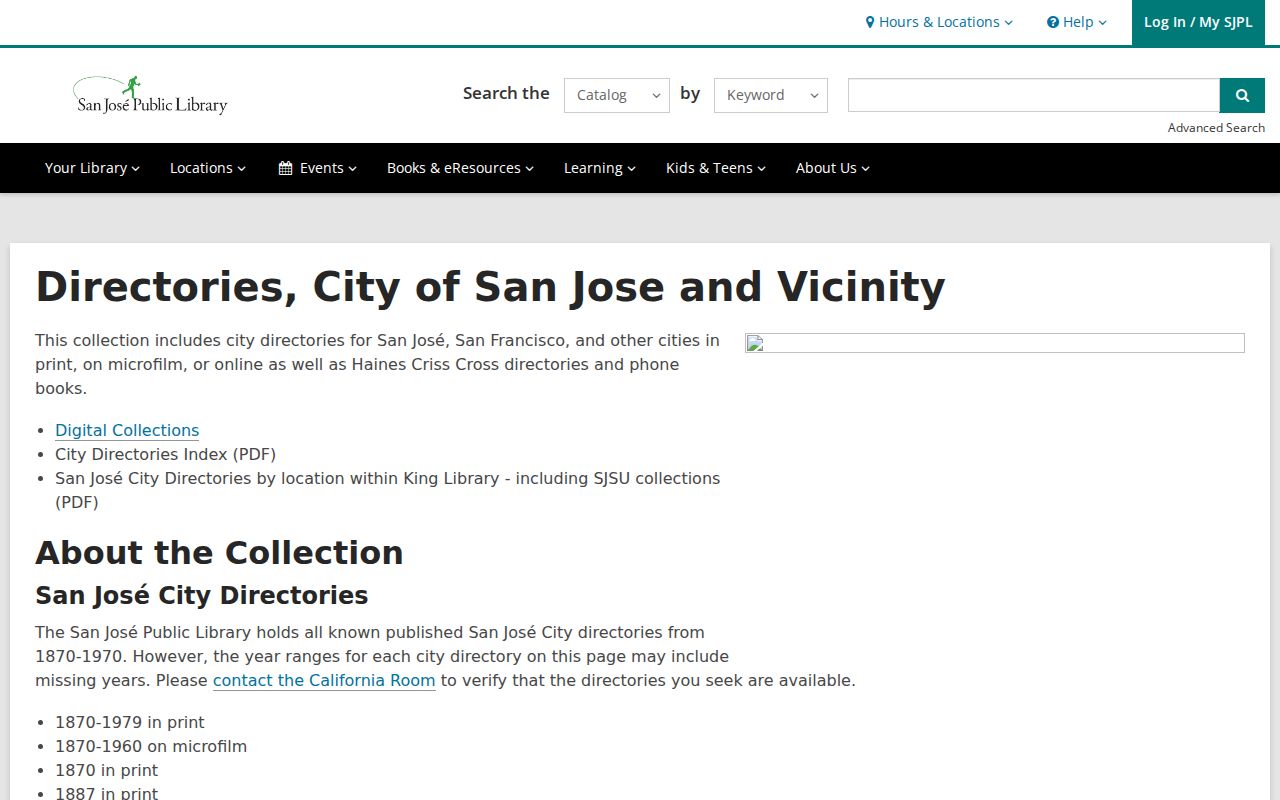
The main San Jose city directory shelf is the California Room at King Library. Its authoritative inventory reports all known published San Jose directories for 1870 to 1970, a print range reaching 1979, and microfilm from 1870 to 1960. Gaps can occur, so a requested year should be confirmed before travel. Haines Criss-Cross and Pacific Bell reverse directories begin in the mid-1960s and carry address-first research beyond the end of the city-directory run.
| Collection | Years | Where held | Access |
|---|---|---|---|
| San Jose and Santa Clara directories | 1870-1979 print; known published 1870-1970 | King Library California Room | In-library volumes; verify gaps |
| Microfilm directory run | 1870-1960 | California Room | In-library reader |
| Digitized city volumes | 1870, 1887, 1920; business sections 1870-1918 | San Jose Public Library digital collections | Online scans |
| Haines and Pacific Bell reverse directories | Mid-1960s and later | California Room | Address-first, in person |
| Suburban San Jose coverage | 1968-1974 | California Room | Check surrounding-place coverage |
| Sanborn fire-insurance maps | 1884-1967 local run; 1891 LOC volume | Library collections and Library of Congress | Catalog or public-domain scan |
| Federal census schedules | 1850-1950 public schedules | NARA and library databases | Online or in-library research |
The San Jose directory holdings inventory is the source for the shelf range, reverse-directory note, and digitized volume list.
The years do not form one seamless database. A printed volume may cover a nearby suburb, omit a household, or use a different publisher than the year before. Keep the volume title, edition year, and page reference together.
California Room Access for San Jose Directories
The California Room is on the fifth floor of Dr. Martin Luther King Jr. Library at 150 E. San Fernando Street. The captured schedule was Monday 1 to 6, Tuesday through Friday 11 to 6, Saturday 1 to 6, and Sunday closed. Hours can change, so confirm before a trip. The local-history desk combines San Jose Public Library and San Jose State University resources, with staff who can help identify a directory year or neighborhood source.
The collection is noncirculating. It includes more than 1,000 maps from the 1860s through the 1980s, more than 2,500 photographs, school yearbooks, directories and phone books, newspaper and clipping microfilm, aerials, permits, and genealogy databases. Fragile or uncataloged material may require staff handling, identification, or an appointment. The on-site index sorts Subject, Title, Author, Location, Call Number, and Source. “Location” points to the physical file or vault item rather than a street search result.
The California Room collection page gives the local access point for local directory research.
California Room staff can help locate a volume or explain a finding aid, but an unlimited person search is not a library service. A focused year, surname, street, or call number makes the visit more productive.
San Jose Directory Titles and Years
Publisher names matter because local volumes came from more than Polk. The 1870 book was Colahan and Pomeroy's The San José City Directory. Other documented title anchors include an 1874 volume, a 1875 multi-county handbook and directory, an 1881-82 San Jose and Santa Clara County volume, an 1884-85 volume, and an 1887-88 Uhlhorn and McKenney volume. City historic reports cite R.L. Polk and Company directories across 1870 to 1978, but the title page controls the publisher for a cited edition.
Digitized scans make the 1870, 1887, and 1920 volumes easier to compare, along with business sections from 1870 to 1918. The print shelf still matters for a year not scanned, a page that is hard to read, or an edition whose title and publisher clarify a name change. Use the directory's own title page, preface, and abbreviation key before treating a format as stable across decades.
| 1870 | Colahan and Pomeroy, The San José City Directory; a complete digital volume is listed. |
|---|---|
| 1887-88 | Uhlhorn and McKenney title anchor; the 1887 volume is digitized. |
| 1913 | A street index appears, although History San José describes its reverse index as 1914. |
| 1920 | A complete digital volume is listed for comparison with the printed shelf. |
| 1979 | The reported print range ends; reverse directories continue the address-first trail. |
The one-year street-index discrepancy is a reason to inspect the actual volume, not to force a single date into every catalog description.
Reading a San Jose City Directory Entry
A San Jose city directory entry is a compact historical record. A typical Polk-style volume can contain a surname, given name or initial, spouse in parentheses, occupation or trade, business affiliation, residence address, and short marks such as “h,” “r,” “bds,” or “wid.” In context, “h” can mean house, “r” can mean rooms or resides, “bds” can mean boards, and “wid” can identify a widow. The key at the front of the same volume controls the meaning.
Property and household coverage changed. Before 1911, directories listed property owners. Starting in 1911, spouses and children over 18 were included. That shift can make a later entry look fuller without proving that the earlier household lacked those people. Owner marks and residence notation also vary by volume, so a symbol is a clue to interpret, not a substitute for a deed or census schedule.
| Name line | Surname, given name or initial, and sometimes a spouse in parentheses. |
|---|---|
| Occupation or trade | The role or trade printed for the person, sometimes beside a business affiliation. |
| Residence | House number and street, with short notation such as “r” or “bds.” |
| Owner mark | A volume-specific sign that may distinguish a property owner from another listing. |
| Widow notation | A mark such as “wid Charles,” useful when paired with an obituary or probate record. |
- Criss-cross directory
- An address-order section that starts with a street and number, then lists a subscriber or occupant.
- Householder index
- A name-oriented route to the principal household listing in a particular edition.
- Abbreviation key
- The volume's decoding list for short marks, symbols, occupations, and ownership notation.
Criss-Cross Pages for San Jose Addresses
Alphabetical and address-order pages answer different questions. The alphabetical section finds a surname and may add a spouse, trade, or address. The criss-cross section starts with the street and number, which makes it useful when a house is known but the occupant's name is not. Haines and Pacific Bell volumes from the mid-1960s extend that method into the years after the printed run ended in 1979, including surrounding cities and unincorporated places.
Copy the street name, number, listed name, and edition year before turning to the alphabetical entry. Note whether the entry is a private residence, a business listing, or a telephone subscriber record. Telephone books can omit people who had no listing, while a volume can omit children or other household members. The address-order entry is therefore a lead for a local directory search, not a complete household roll.
Modern parcel work follows a different path. The San Jose Street Directory explains the current Assessor, GIS, deed, and permit chain, while the historical shelf supplies older address clues.
Trace San Jose Families Across Editions
A household trail grows from repeated, dated observations. Start with a known surname and year, then preserve the exact spelling, address, spouse, and printed trade. Follow the entry forward and backward, but leave room for publication lag, military absence, a change in household structure, or a missed listing. A directory disappearance is not proof of a move.
- Choose a known year and address, then photograph or transcribe the alphabetical and street-order entries.
- Check the next earlier and later available editions, recording every spelling, address, spouse, and notation change.
- Use the criss-cross section to test the address independently and identify nearby listed households.
- Pair the directory evidence with the closest census schedule, deed, permit, newspaper notice, or map.
- Use obituary, cemetery, or probate evidence to test whether a later absence reflects death, an heir trail, or a different address.
For San Jose family history, the most useful comparison is often a small set of years rather than every annual volume. A 1913 street index can bridge a surname page and an address, while the 1911 household change explains why spouses and older children appear more often in later editions.
Pair San Jose Directories with Census Records
Federal census schedules cover San Jose households from 1850 through 1950 in the public release. The 72-year rule controls access, so the 1960 census is scheduled for release in 2032. A directory can fill the years between census snapshots, while a census can add ages, relationships, and other household context missing from a directory. The 1890 population schedules were destroyed, so a gap there requires other sources.
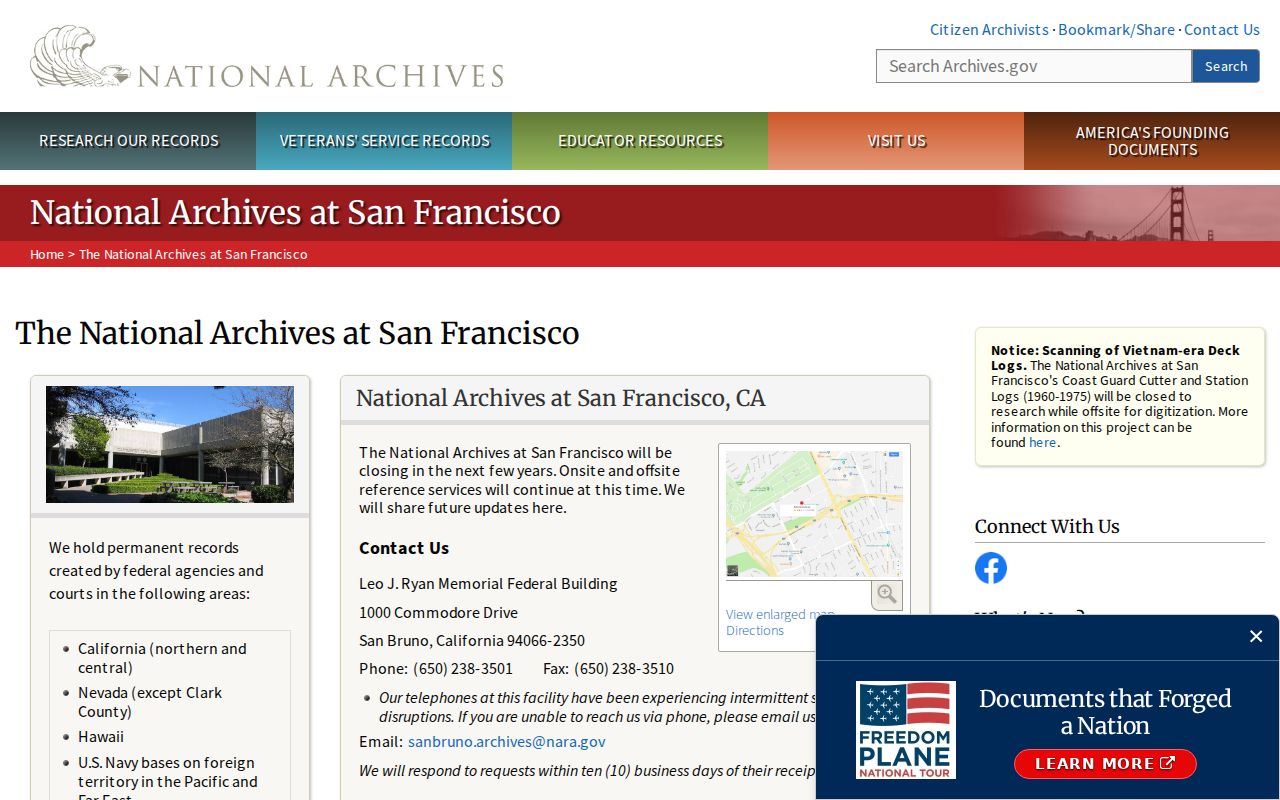
The National Archives at San Francisco in San Bruno serves federal records relevant to Northern California. NARA and library genealogy databases can be searched online or in person, and FamilySearch catalog entries should be tested under “California, Santa Clara.” Some image sets require a FamilySearch Center or affiliate library. Keep the census enumeration district and schedule year with the address note.
The NARA regional holdings source shown here anchors the census access route for a directory investigation.
Compare a directory address with a census address only after checking street names, numbering, and jurisdiction. A similar surname in the same city is not enough to join two households.
Sanborn Maps for San Jose Addresses
Sanborn fire-insurance maps add a building layer to a historical directory trail. The local documented run covers 1884 to 1967, and the Library of Congress has an 1891 San Jose volume with 83 sheets, including Santa Clara. A map can show a structure's footprint, materials, use, street number, and nearby features for the edition date.
The Library of Congress Sanborn collection provides a public-domain scan route. Library map collections and the California Room can supply local catalog context for other updates. Match the map sheet to the directory year, then check whether a street number or building footprint changed before treating an address difference as a household move.
History San Jose Beyond City Directories
History San José's Research Library extends the local directory shelf with more than 5,000 linear feet and more than 70,000 photographs. Its collections include family, personal, corporate, and organization papers, maps, architectural drawings, ephemera, postcards, municipal records, oral histories, newspapers, and film. Named tools include Jack Douglas property and person files, searchable abstracts of title, county yellow and white pages from 1905 to 2018, directories from 1870 to 1979, and biographical, family, and subject clipping files.
The History San José research collection uses online catalog records and OAC finding aids, with research contact through research@historysanjose.org. SJSU Special Collections and the Sourisseau Academy add yearbooks, photographs, local-history material, and institutional records. Congregation archives, cemeteries, funeral notices, and non-English newspapers can add a name clue, but each keeper sets its own access rules.
San Jose record history reaches from the 1777 pueblo to county record series that begin near 1850, then through printed directories and privacy-limited digital portals. That long change in record form is why a family trail may need a shelf, a map, and a custodian request in the same research session.
Name Marks in San Jose Directories
San Jose's multilingual history makes spelling control essential. Search more than one form of a surname, including diacritics, compound names, spacing changes, transliteration, married or maiden names, and initials. Older indexes may flatten marks or shorten a name, while a directory entry can preserve a form that is missing from a later index. Compare the address, spouse, trade, and year before deciding that two spellings describe different people.
California's 2025 AB 64 change allowing specified diacritical marks on vital records from 2026 is a timely reminder that record systems can change their treatment of names. The California vital-records guidance belongs beside, not inside, the historical directory search. A vital record has its own eligibility and copy rules, while a historical directory remains a period listing.
Spelling checkpoint. Preserve the printed form, record the alternate form used in a search, and verify the address before linking two San Jose directory entries.